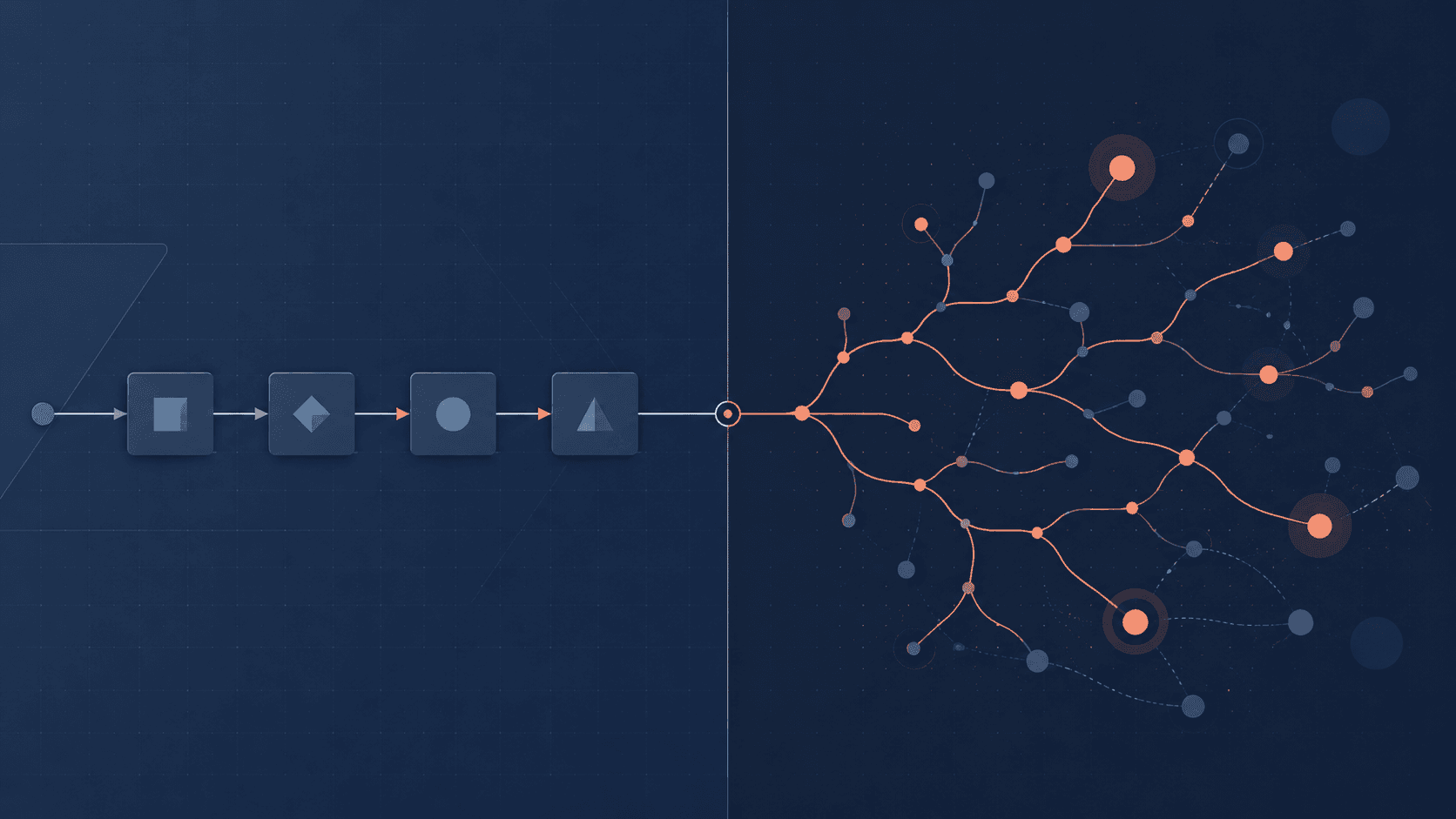
Currently, AI agents are one of the most exciting developments in AI.
They're capable of reasoning, planning, using tools, and adapting to new information.
But that doesn't mean every application needs one.
A common mistake is assuming that every problem becomes better once an AI agent is added. In reality, many problems are simply deterministic workflows. The best engineering solution is usually the simplest one that satisfies the requirements.
What Is a Deterministic System?
A deterministic system is one where:
- The inputs are clearly known
- The expected output is clearly defined
- The steps to get from input to output are already known
Given the same input, the system will always produce the same result.
There is no uncertainty. There is no guessing. There is no need for reasoning. In these situations, a simple workflow is usually the correct solution.
Example 1: User Registration
Imagine someone creates an account on your website. The application needs to:
1. Validate the email
2. Hash the password
3. Save the user
4. Send a verification email
Every user follows exactly the same process. The application already knows what to do. Nothing needs to be decided.
An AI agent would simply add unnecessary complexity. A workflow is enough.
Example 2: Invoice Processing
A company receives invoices by email. The process is always the same:
1. Download the PDF
2. Extract the invoice information
3. Validate the supplier
4. Store the data
5. Notify the finance team
The workflow never changes. The inputs are known. The output is known. There is no uncertainty.
A workflow is the right engineering choice.
When Do You Actually Need an AI Agent?
AI agents become valuable when the system doesn't know exactly what to do next. The next action depends on information that is discovered during execution. Instead of following predefined rules, the system must reason, evaluate options, and make decisions.
That's what makes an AI agent useful.
Think of an AI agent as the brain of the system. You only need a brain when the system has to think.
Example 1: Travel Planning
A user asks:
"Plan a two-week trip to Japan under $3,000. I enjoy hiking, photography, and local food."
There isn't one correct answer. The system may need to:
- Compare flights
- Check hotel prices
- Consider the weather
- Balance the budget
- Adjust the itinerary
Every user is different. Every plan is different. The system has to reason before producing an answer.
This is a great use case for an AI agent.
Example 2: Customer Support
A customer says:
"My package says 'Delivered,' but I never received it."
What should happen next? It depends. The system might need to:
- Check tracking information
- Read previous conversations
- Verify the delivery address
- Decide whether to issue a refund
- Escalate the case to a human
There isn't one fixed sequence of actions. The system has to decide what to do based on the available information.
An AI agent makes sense here.
The Simple Rule
Before building an AI agent, ask yourself one question:
Does the system already know exactly what to do?
If the answer is yes, build a workflow.
If the answer is no, and the system must reason, adapt, or make decisions under uncertainty, then an AI agent is probably the right choice.
Workflow vs. AI Agent
Choose a workflow when:
- Inputs are known
- Outputs are known
- Business rules are already defined
- The same input always produces the same result
Choose an AI agent when:
- The next step is unknown
- The system must reason
- Information is incomplete
- Multiple decisions must be made
- The solution changes depending on the situation
The Engineering Mindset
Good engineering isn't about using the most advanced technology. It's about choosing the right technology.
Adding an AI agent to a deterministic workflow is like hiring a pilot to drive a bus. The pilot is highly skilled, but the job doesn't require those skills.
The same is true for AI agents. Use them when the problem requires intelligence. Don't use them when simple automation already solves the problem.
Here's What to Keep in Mind
Workflows are built for certainty. AI agents fit better for tasks involving uncertainty and guessing.
- If the inputs are known, the outputs are known, and the execution path is already defined, you don't need an AI agent.
- A simple workflow will be faster, cheaper, easier to test, and easier to maintain.
- Reserve AI agents for problems that genuinely require reasoning, planning, and adaptability.
If the system already knows what to do, it doesn't need a brain. Build a workflow, not an AI agent.